Controlled AI & Component Integration
Connecting specialized harnesses, interchangeable models, connectable memory, and external software tools through deterministic adapters and verification gates.
Three-Layer Integration Stack
Decoupling business logic from external APIs, memory stores, and inference providers through verified adapters.
Schema & Context Normalization
Normalizes heterogeneous external payloads, documents, and events into typed structures before entering any harness.
Connectable Memory & Tool Bus
Binds workspace-scoped memory and authorized external tools to the active worker harness without exposing raw credentials or unbounded permissions.
Gate Verification & Audit Trace
Intercepts outbound tool calls and responses, verifying compliance against operational limits before committing state changes.
AI Integration — Architectural Planes & Sequences
Interactive perspective compositions illustrating the operational layers of this KRONS line.
Contract to Connected Component
Direct correspondence between the integration contract and the live behavior of the coupled component.


Complementary Structural Schematic
Every visual composition in KRONS is engineered as a resolution-independent vector diagram coupled with deterministic operational specifications.
Connected Areas in KRONS
Navigate directly to adjacent architectural lines and operational surfaces.
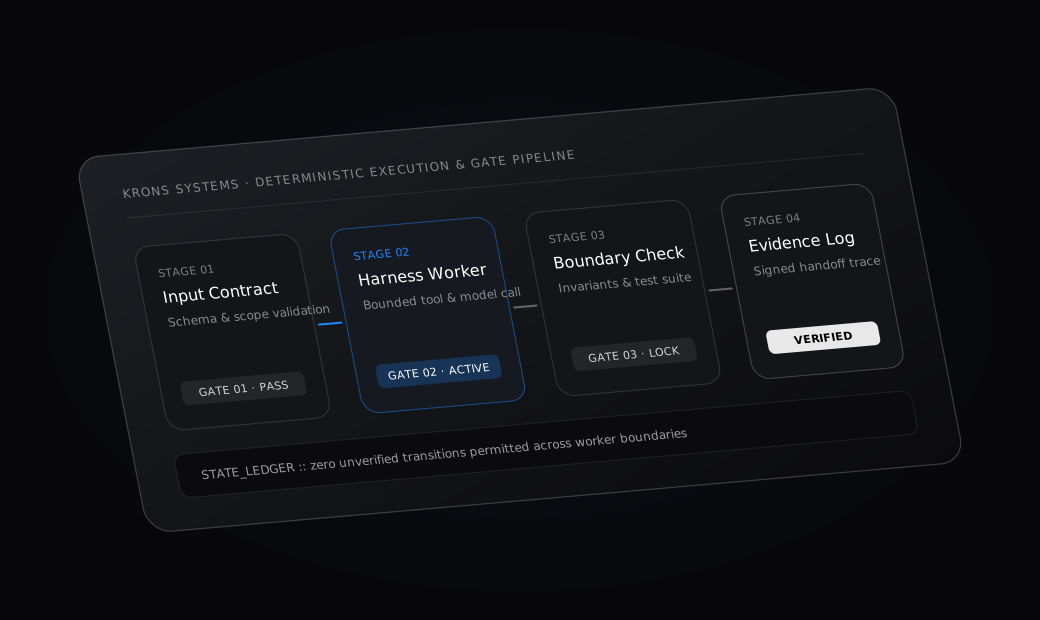
Systems
The structural backbone of KRONS: governing how specialized functions communicate, pass verified work artifacts, enforce execution gates, and preserve end-to-end auditability.
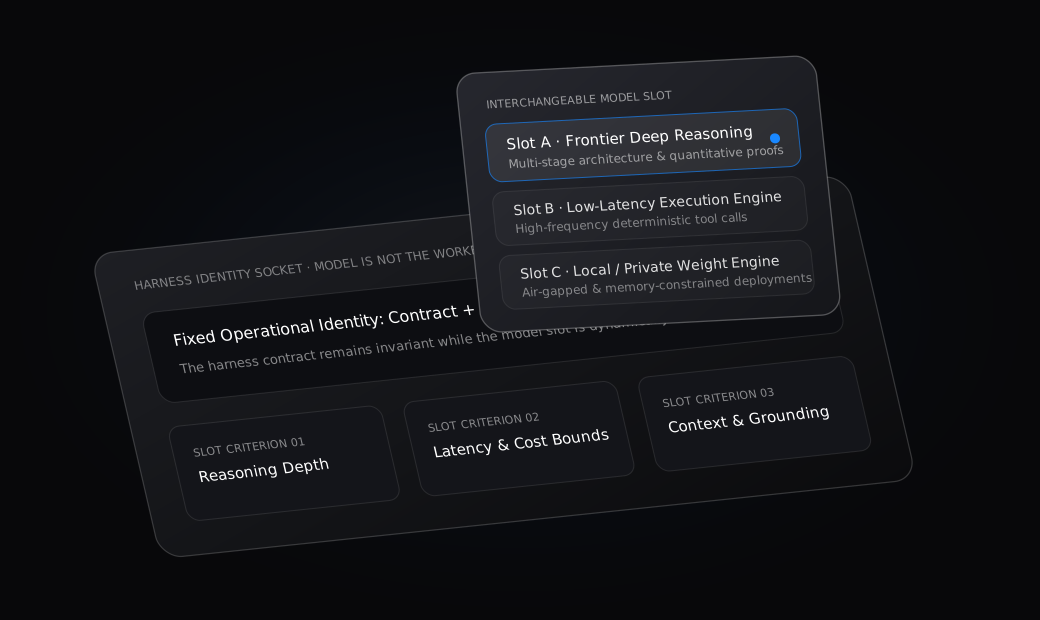
Models
In KRONS, the language model is never the worker’s identity. The harness defines the operational identity; the model occupies an interchangeable slot selected strictly for its adequacy to the task and harness rules.

Software
Transforming reusable KRONS core technology and formal specifications into high-precision software products and operational interfaces.