From Isolated Workers to Full-Company Operations via Coordinated Harness Flows
Architectural principles for assembling synchronized multi-harness workflows that cover the complete operational lifecycle of an organization.
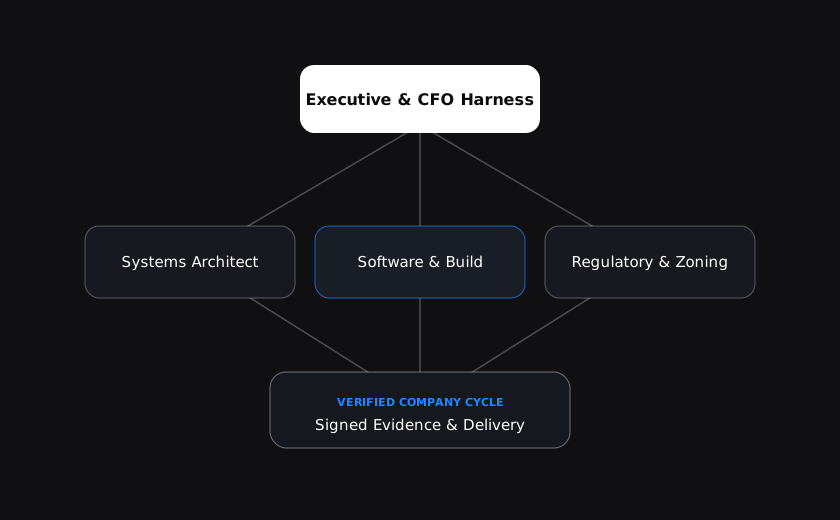
1. Inter-Functional Handoffs as First-Class Contracts
When scaling from a single specialized worker (such as a CFO or Software Architect harness) to an entire enterprise workflow, the primary engineering challenge shifts from single-task execution to inter-departmental handoff fidelity.
KRONS models an organization as a directed graph of harnesses. Every edge between executive planning, financial control, systems engineering, and regulatory compliance is governed by a verified handoff contract and shared connectable memory.
- Explicit functional topology across executive, engineering, and operational roles.
- Gate verification between upstream outputs and downstream inputs.
- Unified evidence ledger spanning the entire organizational workflow.
2. Modular Scalability Across Sectors
By keeping harness contracts modular and model-agnostic, KRONS can assemble full-company operational flows tailored to specific industries while keeping deployment and commercial modalities flexible.
Related Architectural Papers
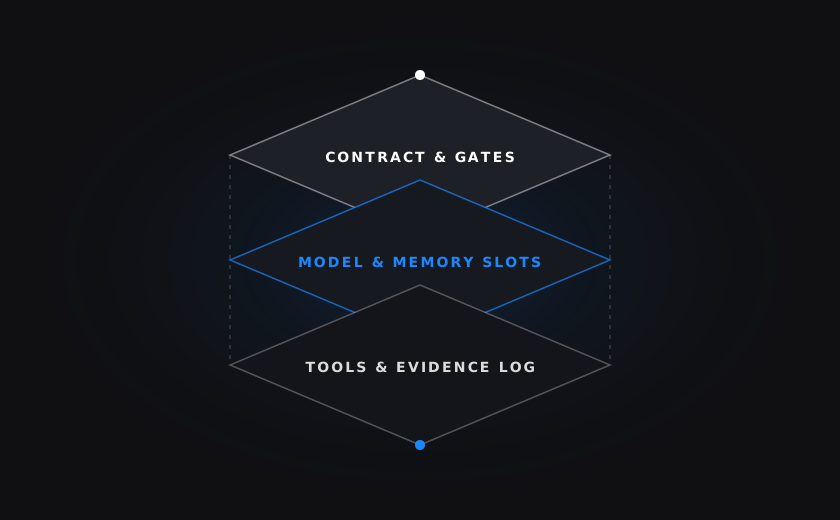
Universal Harness Architecture: Operational Identity Beyond the Model
Why a specialized worker’s identity belongs to an open, 9-element verifiable harness—contract, skills, tools, boundaries, tests, model slot, memory, gates, and evidence—rather than a fixed language model.
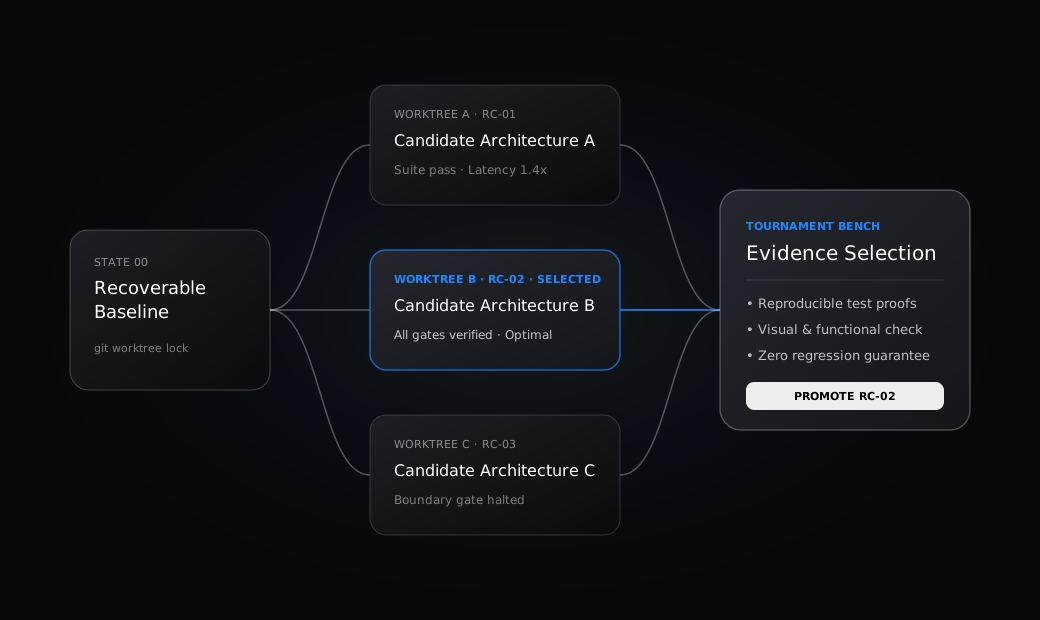
Evidence-Driven Manufacturing: Isolated Worktrees, Release Candidates, and Tournament Benches
How KRONS builds, tests, and selects technology: recoverable baselines, isolated worktrees, release candidates, and tournament benches.